
Fleet Electrification Software
ServaTerra developed a fleet electrification software for Dunsky Energy Consulting.
Dunsky's clients face what is termed the fleet electrification problem, wherein a fleet of gas-powered vehicles owned by a business or government must be replaced with electric alternatives to meet constraints on greenhouse gas (GHG) emissions. Determining the optimal timeline for transitioning a fleet is a challenging problem that depends on economic factors, vehicle usage statistics, client constraints, and the availability of alternative technology.
To address this challenge, ServaTerra developed a modelling and optimization software package that automatically solves the fleet electrification problem. This tool has enabled Dunsky's team to deliver optimized electrification strategies for fleets of any size and complexity.
The software addresses the fleet electrification problem by modelling the total cost of ownership (TCO) and greenhouse gas (GHG) emissions associated with the client’s fleet of vehicles. It then uses a custom optimization algorithm to compute when each gas-powered vehicle should be replaced and what type of electric vehicle it should be replaced with in order to minimize TCO and satisfy GHG targets. A block diagram of the algorithm is shown in Figure 1.
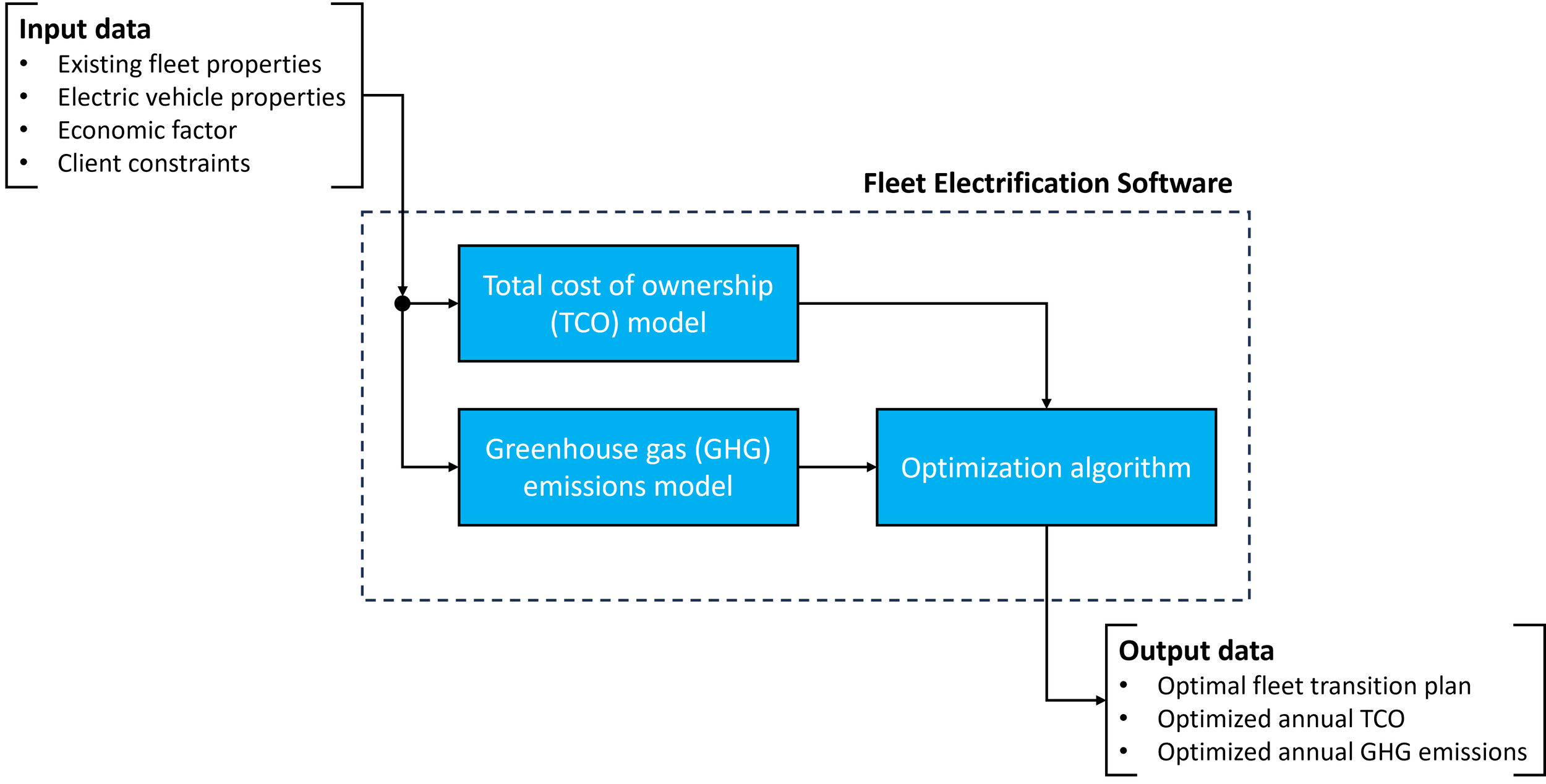
Figure 1. High-level functional block diagram of fleet electrification software.
As inputs, the model takes in all relevant fleet, economic, and client parameters:
Properties of the existing gas-powered fleet (e.g., sale prices and depreciation, vehicle age and mileage, annual usage and emissions rates, maintenance costs)
Properties of electric alternatives (e.g., availability of electric/hybrid alternatives, sale prices and depreciation, effective emissions rates via electricity production, maintenance costs)
Economic factors (e.g., gas and electricity pricing, carbon tax rates)
Client constraints (e.g., emissions targets, annual budgets, time horizon for transitioning fleet)
As outputs, the software generates a table listing the optimal date at which to sell each gas-powered vehicle along with the recommended electric vehicle type to purchase. Additionally, the software outputs charts for visualizing the impacts of the proposed transition strategy. For example, Figure 2 shows the number of vehicle replacements recommended by our algorithm per year along with the maximum allowable number of replacements based on client budgetary limits.
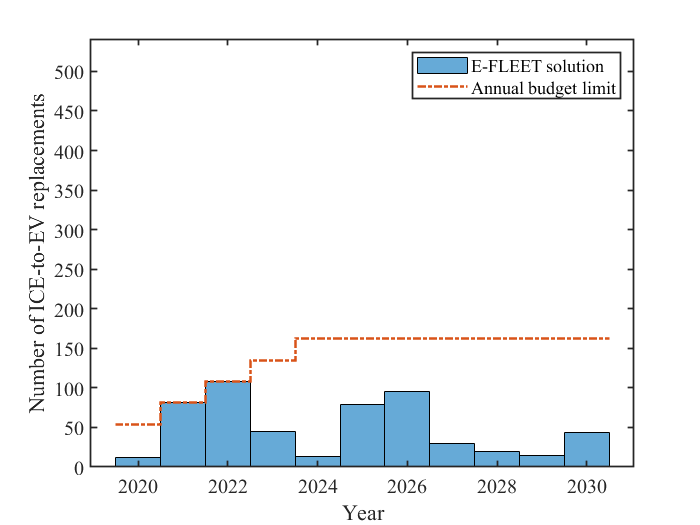
Figure 2. Maximum number of annual vehicle replacements computed by the fleet electrification software. The dashed orange curve shows the constraints imposed by customer budget limitations.
Additionally, the Figure 3 shows the impact of the recommended transition plan on TCO savings and GHG emissions reductions. These plots compare TCO and GHG emissions associated with the status-quo scenario (i.e., no fleet transition) and the optimal scenario proposed by our software.
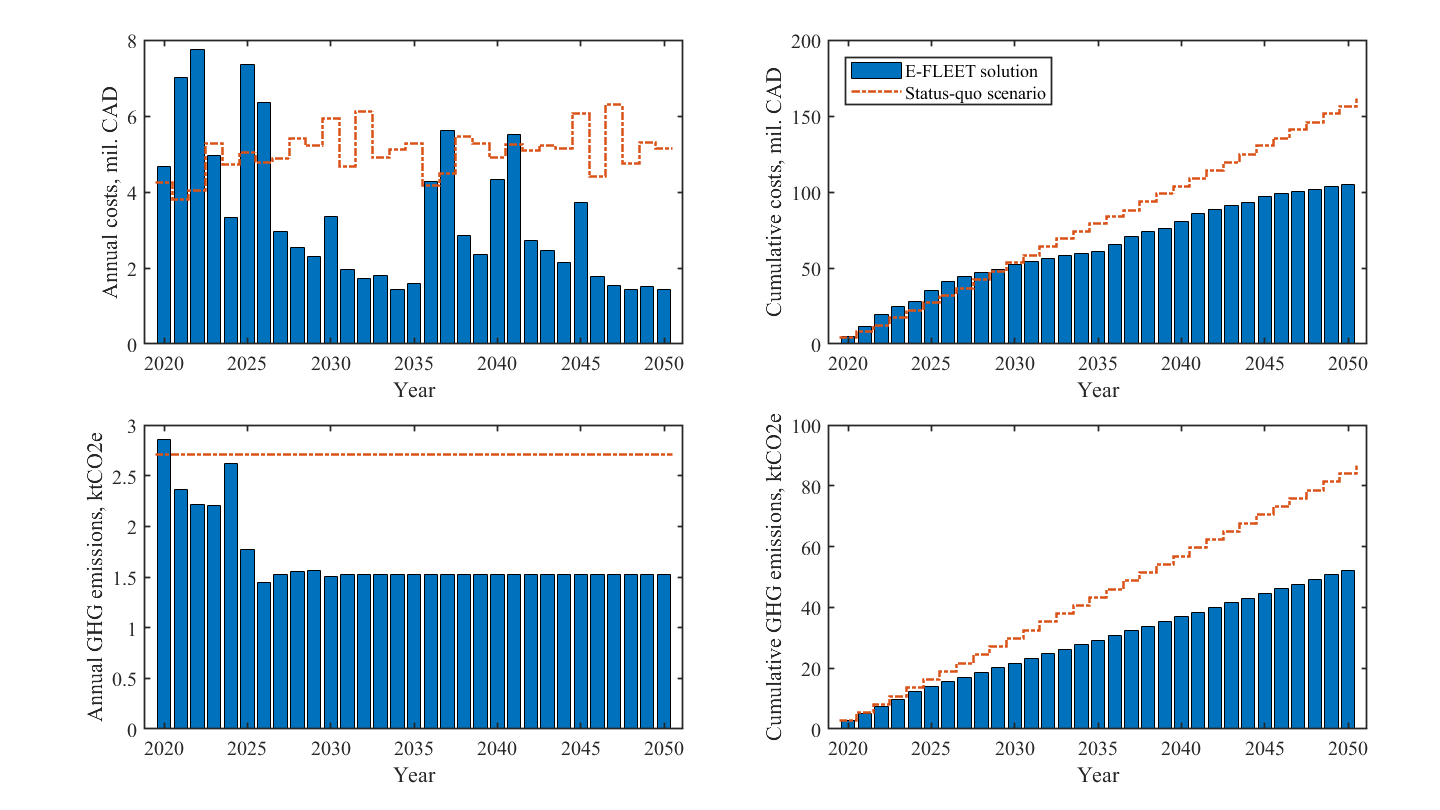
Figure 3. Annual and cumulative TCO savings and GHG emissions from (i) optimal fleet electrification scenario vs. (ii) status-quo scenario with no fleet transition.
Since 2020, the fleet electrification software has been used by Dunsky Energy Consulting to serve a variety of clients in public and private sectors. The software has enabled their consultants to take on a greater number of clients with larger fleet sizes, leading to cost and time savings for their business.
A description of the fleet electrification tool is available on Dunsky’s website.